HR compliance is already consuming more than a quarter of the working time of 34% of HR respondents at small and mid-sized businesses, according to UKG's HR function research. That finding challenges the familiar idea that compliance is a once-a-year handbook review. For an SMB, compliance is a daily operating system made of policies, deadlines, approvals, payroll controls, benefits records, employee notices, and documented follow-up.
The strongest HR compliance best practices focus on the evidence your company can produce when someone asks a difficult question. Can you show which policy an employee received? Who approved a pay change? When was a leave request reviewed? Where are the benefits notices, I-9 records, training completions, investigation notes, and remediation decisions?
The following practices connect foundational documentation with hiring, pay, benefits, leave, workplace protections, data security, audits, and jurisdictional monitoring. Benely can help connect benefits, payroll, onboarding, and compliance workflows through a centralized platform, while government resources from the U.S. Department of Labor, Equal Employment Opportunity Commission, Internal Revenue Service, U.S. Citizenship and Immigration Services, and Occupational Safety and Health Administration remain important references for legal requirements.
Table of Contents
- 1. Implement Automated Compliance Documentation and Record-Keeping Systems
- 2. Establish Clear, Written HR Policies and Update Them Regularly
- 3. Create and Monitor I-9 Compliance and Employment Eligibility Verification
- 4. Implement Pay Equity Analysis and Wage and Hour Compliance Programs
- 5. Ensure Compliant Benefits Administration and Proper Plan Documentation
- 6. Maintain FMLA Compliance with Proper Notice and Tracking
- 7. Develop and Enforce Anti-Discrimination and Anti-Harassment Policies
- 8. Establish Proper Employee Classification Procedures
- 9. Implement Data Privacy and Cybersecurity Compliance for Employee Information
- 10. Conduct Regular Compliance Audits and Gap Assessments
- 11. Build a State-Specific Compliance Calendar and Monitoring Routine
- 11-Point HR Compliance Comparison
- Turn the Roundup Into a 90-Day Compliance Plan
1. Implement Automated Compliance Documentation and Record-Keeping Systems
Audit readiness depends on evidence that staff can retrieve and explain. Centralize employee records, policy acknowledgments, benefit elections, payroll changes, regulatory filings, training completion, and approval history in a system that records who acted, what changed, and when. A shared drive may store documents, but inconsistent filenames and missing ownership make it difficult to reconstruct a decision.
Connect onboarding, payroll, and benefits data where possible to reduce duplicate entry and conflicting records. Benely's benefits and HR solutions support connected workflows for SMBs, while ADP, Workday, and BambooHR provide other approaches to document management and acknowledgment tracking. Select a system based on access controls, audit trails, retention settings, and the workflows your team can maintain.
Build evidence into each workflow
Begin with a gap review. Find missing records, duplicate employee profiles, expired acknowledgments, incomplete approvals, and documents saved outside the approved system. Assign an owner and backup for every record type, including payroll changes, leave documentation, benefits elections, worker classification decisions, privacy requests, and I-9 materials.
Use controls that make review routine:
- Version history: Preserve current and prior policies with effective dates and approval records.
- Automated reminders: Prompt employees and managers about recertifications, required training, and recurring filings.
- Submission rules: Specify where managers must upload approvals, accommodation records, time corrections, and employee changes.
- Quarterly reporting: Review incomplete records, overdue tasks, access exceptions, and unusual changes through system reports.
Practical rule: A compliance record is complete when someone can find it, confirm its status, and identify the next responsible person.
Schedule quarterly reviews with HR, payroll, benefits, and finance. Automation can flag a missing acknowledgment or inconsistent record, but a named owner must resolve the issue and document the resolution. Store the review outcome with the supporting evidence so the same exception does not reappear without explanation.

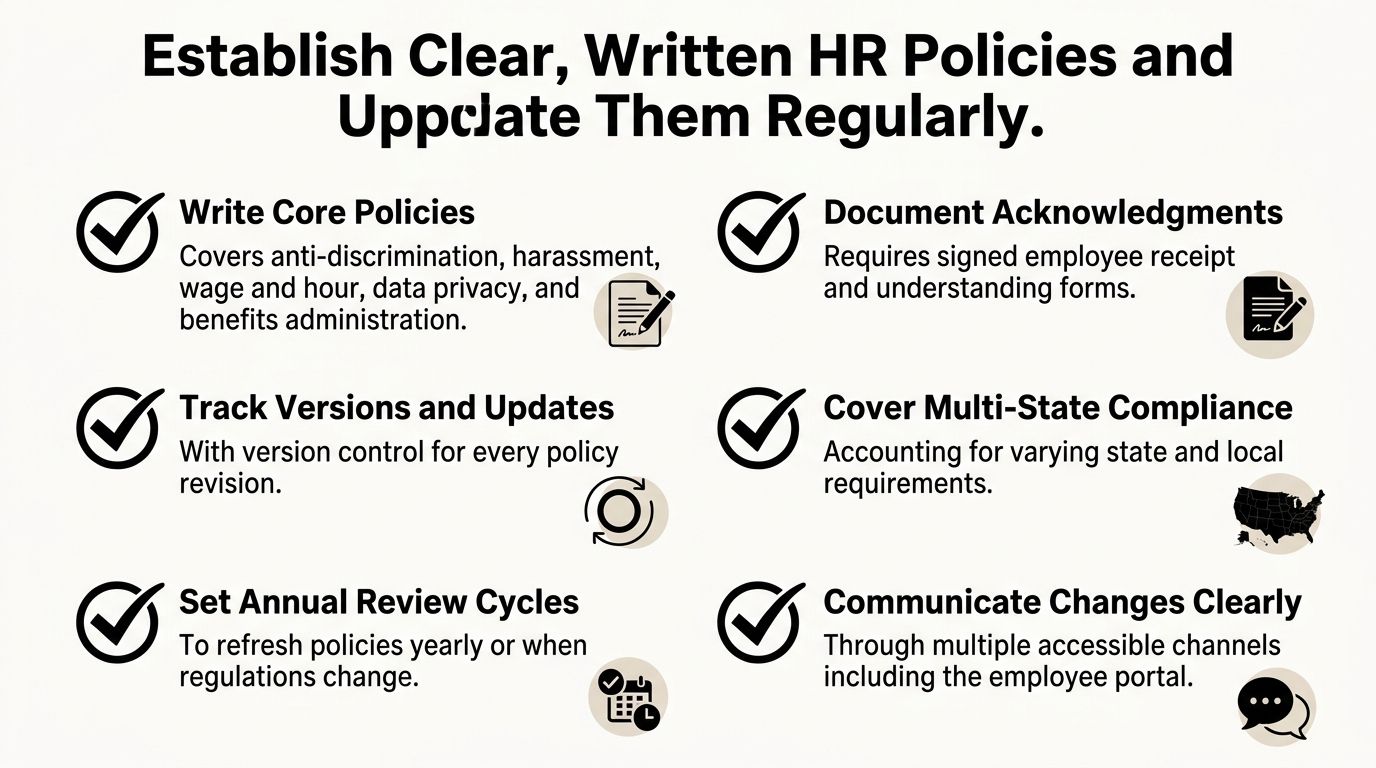
2. Establish Clear, Written HR Policies and Update Them Regularly
A handbook should convert legal requirements into actions managers can follow and evidence HR can review. Cover anti-discrimination, harassment prevention, wage and hour practices, data privacy, benefits, leave, workplace safety, reporting channels, and recordkeeping. State how employees can ask questions or report concerns, and prohibit retaliation.
The legal foundation includes the Fair Labor Standards Act of 1938, which established federal rules for minimum wage, overtime pay, and child labor. The linked history also traces Title VII of the Civil Rights Act of 1964 and the Occupational Safety and Health Act of 1970. Title VII applies to employers with 15 or more employees and prohibits discrimination based on race, color, religion, sex, and national origin.
Make policy evidence easy to verify
A handbook in an employee portal is only reliable when HR can prove which version applied at a given time. Maintain a policy register with the owner, approval date, effective date, affected locations, next review date, and acknowledgment status. Route legal review when laws change or the business enters a new jurisdiction.
Use a short policy-release routine:
- Clear instructions: Describe required behavior, reporting steps, and escalation points in accessible language.
- Acknowledgment records: Capture receipt during onboarding and after material updates, then retain the completion record.
- Change notices: Summarize what changed through the portal, email, manager briefings, or training.
- Manager examples: Show how rules affect scheduling, hiring, discipline, leave, and workplace conduct.
A policy should also identify its owner and the workflow that follows a report, exception, or employee question. That connection helps HR compare handbook requirements with payroll, benefits, leave, privacy, and personnel records instead of treating the handbook as a standalone file.
Policies published by large technology companies may suggest useful organization, but SMBs should adapt them only after legal review. Write for the actual workforce, reporting lines, locations, and systems. Review the policy library at least annually, and reopen affected policies whenever regulatory changes alter daily operations.
3. Create and Monitor I-9 Compliance and Employment Eligibility Verification
I-9 compliance is an evidence problem as much as a hiring task. At each hire, assign responsibility for completing Form I-9, reviewing acceptable documents, protecting records, and resolving errors. The reviewer must follow current instructions, apply the same process to every employee, and avoid requesting a specific document when an acceptable alternative is available.
Use USCIS guidance for current Form I-9 instructions and employment eligibility requirements. Confirm whether E-Verify applies to the business, including cases involving federal contractors or state-specific rules. Record that decision and revisit it when the company enters a new jurisdiction or changes its workforce.
Build a controlled I-9 record trail
Store I-9 forms in a restricted location separate from general personnel files. This reduces unnecessary access and lets HR produce an audit sample without exposing unrelated employee information. A hiring checklist should show who completed each step, when it was completed, and where the record is stored.
Design the checklist around the evidence reviewers will need:
- Completion timing: Track the employee and employer portions against current federal requirements and applicable start-date rules.
- Document review: Train authorized staff on acceptable documentation and anti-discrimination boundaries.
- Corrections: Preserve a visible correction trail. Do not delete or conceal earlier entries.
- E-Verify records: Keep enrollment, case, result, and resolution records when E-Verify is used or required.
- Reverification: Set reminders for documents that require future action, then document the completed review.
Review retention directly against current USCIS guidance. Separate active and terminated employee records according to the applicable retention period, including the longer-period rule where relevant. Link the I-9 checklist to onboarding, payroll, and personnel workflows so a missing step is visible rather than buried in a separate folder.
Run a mock audit by sampling records, checking completion dates, confirming restricted access, and logging remediation. Correct the process while preserving the underlying evidence.
4. Implement Pay Equity Analysis and Wage and Hour Compliance Programs
Pay compliance depends on evidence that explains each decision. Maintain a connected record of job descriptions, exemption analyses, pay rates, time entries, overtime approvals, deductions, and compensation changes. The FLSA exempt salary test addresses one part of exemption analysis, while applicable state and local rules may add requirements.
The FLSA provides a federal foundation for minimum wage and overtime duties. Review the applicable rule for each jurisdiction, then make payroll, HR, and managers follow the same documented process.
Build an audit trail for pay decisions
A pay equity review should compare employees performing comparable work and investigate differences that lack a documented explanation. The goal is consistent decision-making, not identical pay. Responsibilities, experience, performance, location, skills, and market conditions may support different compensation, provided the company records which factors applied and uses them consistently.
Organize the review around evidence:
- Role mapping: Keep job families, levels, reporting relationships, and essential duties current.
- Compensation rationale: Require written business reasons for hiring offers, increases, bonuses, and promotions.
- Time controls: Preserve time cards, schedules, wage-rate tables, and records of deductions or increases.
- Classification review: Recheck exempt, nonexempt, employee, and contractor decisions against current duties and working arrangements.
- Manager training: Set clear overtime approval rules and prohibit off-the-clock work.
Run the review on a recurring schedule. HR should compare compensation and classification records, payroll should confirm that approved rates and hours were applied, and managers should resolve missing documentation before the next pay cycle. That coordination turns an analysis into an operating routine rather than a one-time report.
The DOL generally says payroll and related records should be retained for at least three years, while wage-calculation records generally should be kept for two years, according to its recordkeeping guidance. Confirm the rule for each record type and jurisdiction before setting deletion schedules, and document the retention decision.
5. Ensure Compliant Benefits Administration and Proper Plan Documentation
Benefits records need to prove what an employee was eligible for, what the employee elected, which notices were issued, and how payroll applied each change. A carrier file, payroll deduction, or HR platform can be accurate on its own while the records disagree. Review the handoffs, not just the individual systems.
Create one controlled benefits library for plan documents, Summary Plan Descriptions, Summary of Benefits and Coverage documents, HIPAA notices, certificates, carrier communications, and employee acknowledgments. Record the plan year, effective date, approval, and employee population for every version. This lets HR identify the rule and document that applied on a given date.
Build an evidence trail from eligibility to payroll
Start with an eligibility matrix covering waiting periods, employee classes, life-event rules, dependent documentation, termination handling, COBRA responsibilities, and payroll deductions. Benely's guidance on what a Summary Plan Description includes can support the documentation process, while plan-specific obligations still require review.
Use a reconciliation log to connect each control:
- Notice calendar: Track SBC distribution, enrollment communications, annual notices, and event-driven notices.
- Change records: Capture approvals for enrollments, life events, retroactive changes, and terminations.
- Payroll comparison: Match elections and carrier files to deductions after enrollment changes.
- Vendor file: Request current compliance documents from carriers and benefits vendors.
- Exception queue: Assign owners and resolution dates for late enrollments, missed events, and disputed deductions.
A monthly review between HR, payroll, and benefits administrators should resolve discrepancies before the next payroll cycle. Benely can connect benefits administration with payroll and onboarding workflows, reducing manual handoffs for an SMB. Integration still leaves governance with the employer. A designated owner must approve eligibility rules, monitor notices, retain evidence, and investigate exceptions.
6. Maintain FMLA Compliance with Proper Notice and Tracking
A leave case is audit-ready only when HR can connect the request, eligibility decision, notices, time away, payroll treatment, and return-to-work steps. Leave administration also involves benefits continuation, medical information, manager communication, and jurisdiction-specific rules. Spreadsheets can work for a small caseload, but intermittent leave and employees in multiple jurisdictions make manual tracking harder to control.
Begin with the applicable FMLA coverage and eligibility requirements. The Department of Labor FMLA resource provides official information about coverage, employee rights, notices, certification, and restoration. State and local programs may provide broader protections, so the FMLA review should feed into a wider leave assessment. Employers with Maryland employees can also review Maryland paid family leave information when evaluating state-specific obligations.
Build a controlled record for each leave case
Use a case record that separates operational details from confidential medical information. Record the request date, eligibility review, notices and delivery confirmation, certification status, approved parameters, absence history, benefits continuation, payroll instructions, manager updates, and return-to-work actions. Restrict medical information to authorized personnel rather than placing it in the general personnel file.
A workable review routine should reconcile:
- Intake facts: Capture information needed to assess eligibility and coverage without requesting unnecessary medical detail.
- Notice evidence: Retain required notices and confirmation of when and how they were delivered.
- Time and payroll records: Compare timekeeping, leave balances, payroll, and benefits deductions.
- Intermittent leave activity: Review usage patterns and remaining balances without penalizing protected absences.
- Return actions: Document reinstatement, restrictions, accommodations, and benefit changes.
Assign an owner to review open cases, resolve discrepancies, and preserve the record. Benely may coordinate leave, benefits, payroll, and onboarding data, while HR retains decision rights and protects confidential case information. For state-specific programs, consult official agencies and qualified counsel.
7. Develop and Enforce Anti-Discrimination and Anti-Harassment Policies
A policy has value only when employees can report concerns and the company can show what happened afterward. Provide several reporting channels, including a direct HR contact and an alternative route for complaints involving a manager. An anonymous hotline can add privacy, but employees still need an accessible human response.
Title VII provides one federal foundation for discrimination compliance. The EEOC overview of prohibited employment discrimination outlines protected categories and prohibited practices. State and local laws can broaden those protections or add training duties, so maintain a location-based requirements record alongside the policy.
Build an investigation record that can withstand review
Managers should escalate concerns immediately, preserve relevant records, avoid promising a particular outcome, and protect against retaliation. They should not lead sensitive investigations because a complaint reached them first. HR, a trained investigator, or outside counsel may be the better choice, depending on the allegation and the organization's structure.
Create a case file with:
- Intake facts: Record the allegation, reporting date, channel, involved people, and immediate safety concerns.
- Response actions: Document interim measures, conflicts, investigator assignment, and communications.
- Evidence control: Preserve messages, schedules, performance records, witness accounts, and applicable policies.
- Outcome record: State findings, actions taken, and follow-up ownership without unnecessary personal detail.
- Pattern review: Examine recurring allegations, locations, managers, or process failures for broader control weaknesses.
The record should show decisions, not just conclusions. Limit access to sensitive information, retain records under the company's schedule, and track retaliation checks after the case closes.
Training requirements vary by jurisdiction. California requires sexual-harassment-prevention training for covered employers, with interactive training repeated every two years, according to California's official workplace harassment prevention information. Map headcount thresholds, renewal schedules, content, and supervisor requirements by location, then assign an owner to review the calendar and preserve completion evidence.
Employees judge a reporting system by what happens after the report, not by how polished the policy looks.
8. Establish Proper Employee Classification Procedures
Classification should be decided from the working relationship in practice and supported by an evidence file. A contractor label in an agreement does not resolve the issue if the company controls the work, sets the schedule, supplies tools, or treats the engagement as permanent.
Use the IRS worker classification guidance and related IRS resources to organize the review. State tests can differ, so employers operating across locations need a process that records the applicable jurisdiction instead of relying on one federal checklist.
Make the decision reviewable
For each nonemployee relationship, retain the scope of work, control analysis, payment structure, indicators of independence, business registration information where relevant, contract terms, and approval record. Reopen the file when duties, schedule, reporting relationship, location, or duration changes. The goal is an audit trail that connects the classification to operating facts.
Review these questions with the manager and HR:
- Who controls performance: Does the company direct how the work is done, or define only the expected result?
- Who carries business risk: Can the worker realize a profit or loss through independent operations?
- How permanent is the relationship: Does the arrangement resemble an ongoing employee role?
- What does the work represent: Is the service central to the company's regular business?
- What do records show: Do the contract, invoices, communications, and daily practices support the same conclusion?
Classification risk often starts with an operational shortcut. A department may engage someone as a contractor for speed, then assign employee-like hours, supervision, and processes. Train managers to flag changes, require HR or legal approval for higher-risk roles, and record the reason for each decision.
Payroll integration can apply an approved classification consistently across pay and reporting workflows. It cannot settle a legally uncertain relationship. If the facts remain close, obtain qualified counsel and preserve the analysis, approval, and follow-up review date in the worker's compliance file.
9. Implement Data Privacy and Cybersecurity Compliance for Employee Information
Employee information rarely stays in one HR system. An onboarding form may pass data to payroll, benefits, timekeeping, recruiting, background screening, leave administration, or analytics vendors. Each transfer should have an owner, a business purpose, an access rule, a retention period, and a response plan if something goes wrong.
Create a data inventory that identifies personally identifiable information, health information, bank details, tax records, identity documents, investigation materials, and performance data. Record where each category is stored, who can access it, why access is granted, and which vendor or internal team maintains it. Review the inventory after a system change, new vendor, or revised workflow.
Build controls that produce reviewable evidence
The Federal Trade Commission's data security guidance provides practical principles for protecting personal information. Review applicable state privacy laws, HIPAA obligations where relevant, contractual requirements, and breach-notification rules with counsel. Keep the review, decisions, and assigned owners in the compliance file.
Use a control register to track:
- Access management: Apply role-based permissions and multi-factor authentication to HR, payroll, and benefits systems. Review access after transfers and departures.
- Encryption: Protect sensitive databases, backups, portable devices, and data transfers.
- Retention limits: Set retention and secure-destruction rules for each record category, then document completed disposal.
- Vendor review: Confirm security practices, breach duties, data-use limits, and business associate agreements when health data is involved.
- Incident response: Assign responsibility for containment, evidence preservation, leadership communication, vendor contact, and notification analysis.
- Training: Teach employees to identify phishing, handle attachments, share records, and report suspected incidents.
Assess Benely and other HR or benefits vendors against the company's security requirements before implementation. Centralization can reduce uncontrolled copies, while also increasing the need for careful access governance. Reconcile the inventory, permissions, vendor reviews, and incident actions on a scheduled basis.

10. Conduct Regular Compliance Audits and Gap Assessments
Audit evidence should show whether HR controls work in practice, not merely whether policies exist. Compare written rules with time records, manager messages, payroll corrections, leave files, benefits transactions, and termination records. A policy may prohibit off-the-clock work while daily records show repeated corrections. A leave procedure may exist while case files reveal late notices or inconsistent eligibility decisions.
Set the audit scope according to business risk. Review hiring and I-9 records, payroll and timekeeping, benefits, leave, workplace conduct, safety documentation, privacy, training, and termination workflows. OSHA recordkeeping and reporting resources can guide safety reviews. DOL, EEOC, IRS, and USCIS materials can inform the other workstreams.
Make findings traceable to closure
Create one audit file for each review. Record the scope, criteria, sample, evidence examined, finding, risk, root cause, owner, due date, and proof of closure. A self-assessment can expose routine gaps. Independent HR, legal, compliance, or third-party review may provide a more objective assessment for sensitive or high-risk matters.
Use a review cadence that matches the control:
- Scheduled reviews: Test priority controls during planned quarterly or annual cycles.
- Triggered reviews: Reassess after rapid growth, a new location, a payroll incident, a complaint, an acquisition, or a material legal change.
- Process walk-throughs: Ask the employee performing the work to demonstrate the actual workflow and identify undocumented handoffs.
- Remediation tracking: Keep open actions visible until the owner supplies completion evidence.
- Trend analysis: Compare findings over time to locate recurring handoff failures or unclear decision rights.
Benely's employee benefits compliance checklist can support a benefits and HR self-assessment. Include secure data destruction controls in the audit criteria for sensitive records, and verify that completed destruction matches the retention schedule.
A 2026 employment-law compliance report found that 64% of HR teams said compliance became more complex in 2025, 50% said they lacked sufficient resources, and one in five companies faced an employment-related lawsuit in the prior year, with average penalties of $180,706, according to SixFifty's 2026 report. For an SMB, smaller recurring reviews make ownership and remediation easier to manage than one large annual project.
11. Build a State-Specific Compliance Calendar and Monitoring Routine
A headquarters-only model fails once employees work across states. Requirements can depend on the employee's work location, industry, notice type, or employment activity. Maintain a jurisdiction map covering every place employees work, including locations without an office or registered entity.
Build the calendar around both legal changes and operating events. Track onboarding, payroll changes, open enrollment, leave notices, required training, workplace posters, wage updates, benefits filings, policy reviews, safety reporting, and audit checkpoints. Assign each item an owner and backup, due date, required evidence, and escalation path. Store the completed notice, filing, approval, or system record where HR can retrieve it during an audit.
Make monitoring part of routine operations
Use official government sources to identify changes, then ask qualified counsel to interpret rules that affect the business. The DOL workplace poster guidance explains that poster obligations apply to private, federal, state, and local government employers with employees subject to the FLSA. It also notes that the general poster page does not list citations or penalties for failure to post. HR should therefore check other applicable federal, state, and local posting requirements before closing the task.
State training rules show why location-specific monitoring matters. Connecticut requires harassment training for employers with three or more employees, Delaware requires it for employers with 50 or more employees, and New York and Illinois include annual or recurring requirements in several circumstances, according to state harassment-training guidance. Record the applicable rule, assigned employees, completion date, and retained training evidence.
Review the calendar before each payroll and open-enrollment cycle. A worker's location change should trigger checks to wage, leave, notice, policy, benefits, payroll, and training settings. Connected benefits, payroll, and onboarding workflows, including those available through Benely, can reduce handoffs. The compliance owner must still confirm the change, document the review, and retain evidence of the final settings.
11-Point HR Compliance Comparison
| Strategy | Implementation Complexity 🔄 | Resource Requirements ⚡ | Expected Outcomes ⭐ / 📊 | Ideal Use Cases 💡 | Key Advantages ⭐ |
|---|---|---|---|---|---|
| Implement Automated Compliance Documentation and Record-Keeping Systems | Medium–High, integrations and setup required 🔄 | Software, IT/security, training; moderate–high ⚡ | Reliable audit trails, fewer errors, time savings ⭐📊 | Multi‑state payroll/benefits, scaling orgs 💡 | Scalable records, faster audits, error reduction ⭐ |
| Establish Clear, Written HR Policies and Update Them Regularly | Low–Medium, writing and version control 🔄 | HR time, legal review; low–medium ⚡ | Consistent expectations, legal defensibility ⭐📊 | All employers, onboarding and dispute contexts 💡 | Clarity, uniform enforcement, dispute protection ⭐ |
| Create and Monitor I-9 Compliance and Employment Eligibility Verification | Medium, procedural controls and timeliness 🔄 | Training, E‑Verify enrollment, secure storage; medium ⚡ | Federal eligibility compliance, audit readiness ⭐📊 | Federal contractors, high-volume hiring sites 💡 | Avoids penalties, documents good‑faith efforts ⭐ |
| Implement Pay Equity Analysis and Wage and Hour Compliance Programs | High, data analysis and complex rules 🔄 | Compensation analysts, payroll integration, legal; high ⚡ | Reduced litigation risk, equitable pay adjustments ⭐📊 | Organizations with pay disparities or many roles 💡 | Identifies gaps, prevents wage claims, improves retention ⭐ |
| Ensure Compliant Benefits Administration and Proper Plan Documentation | Medium–High, regulatory detail and carrier coordination 🔄 | Benefits platform, carrier liaison, legal; moderate–high ⚡ | ACA/ERISA/HIPAA compliance, smoother audits ⭐📊 | Employers offering group benefits at scale 💡 | Prevents benefits violations, protects privacy ⭐ |
| Maintain FMLA Compliance with Proper Notice and Tracking | Medium, eligibility rules and tracking 🔄 | Leave tracking, payroll integration, manager training; medium ⚡ | Correct leave handling, fewer FMLA claims ⭐📊 | Covered employers and multi‑location orgs 💡 | Consistent leave management, reduced litigation ⭐ |
| Develop and Enforce Anti-Discrimination and Anti-Harassment Policies | Medium, policy + training + investigations 🔄 | Training programs, reporting channels, investigators; medium ⚡ | Safer workplace, lower litigation risk ⭐📊 | All employers, especially larger/mixed teams 💡 | Improved culture, documented prevention efforts ⭐ |
| Establish Proper Employee Classification (W-2 vs. 1099) Procedures | Medium–High, legal complexity and documentation 🔄 | Legal counsel, classification audits, payroll controls; medium ⚡ | Correct tax treatment, avoided back‑liability ⭐📊 | Employers using contractors or gig workers 💡 | Minimizes tax/penalty risk, ensures benefits compliance ⭐ |
| Implement Data Privacy and Cybersecurity Compliance for Employee Information | High, technical and legal controls 🔄 | Security tools, IT, vendor management, training; high ⚡ | Lower breach risk, regulatory compliance, trust ⭐📊 | Any org handling PII/health data (HR/benefits) 💡 | Protects data, reduces breach costs, meets laws ⭐ |
| Conduct Regular Compliance Audits and Gap Assessments | Medium, recurring evaluation and remediation 🔄 | Audit staff or consultants, time for fixes; medium ⚡ | Identified risks, prioritized remediation, evidence of due diligence ⭐📊 | Organizations seeking proactive risk control 💡 | Early risk detection, documented corrective actions ⭐ |
| Build a State-Specific Compliance Calendar and Monitoring Routine | Medium, ongoing monitoring across jurisdictions 🔄 | Monitoring tools, owners, legal input; medium ⚡ | Fewer missed deadlines, jurisdiction clarity ⭐📊 | Multi‑state employers and remote workforces 💡 | Reduces missed notices, assigns accountability ⭐ |
Turn the Roundup Into a 90-Day Compliance Plan
A compliance program becomes useful when your team can operate it during a busy hiring period, a payroll correction, a leave request, an employee complaint, or an agency inquiry. Don't begin by trying to rewrite every policy. Start by identifying the evidence that already exists, the evidence that is missing, and the decisions no one clearly owns.
The first phase should establish visibility. Inventory policies, employee records, benefits documents, payroll workflows, I-9 storage, leave cases, training records, investigation files, worker classifications, vendor access, and jurisdictional obligations. Note where each record lives, who maintains it, when it was last reviewed, and whether the current version is easy to verify.
Immediate actions
- Name an executive sponsor: Assign a leader who can resolve ownership disputes and approve resources.
- Create a risk register: Rank gaps involving payroll, I-9, discrimination, leave, benefits, privacy, safety, and classification.
- Freeze uncontrolled changes: Require approval and version tracking for handbook edits, payroll rules, benefits settings, and automated workflows.
- Map systems: Document how employee data moves between recruiting, onboarding, payroll, benefits, timekeeping, leave, and reporting tools.
- Set escalation rules: Define when HR must involve finance, legal counsel, IT, a carrier, or an outside investigator.
During the first 30 days, verify the hiring and pay workflows. Sample I-9 records, confirm who completes each stage, review document storage permissions, and test how corrections are handled. Examine payroll classifications, overtime approvals, time records, deductions, pay-change approvals, and contractor files. Compare actual manager behavior with written procedures.
Actions for days 30 through 60
Use the second phase to review benefits and leave administration. Reconcile employee elections, carrier records, payroll deductions, eligibility changes, notices, and termination processes. Review open leave cases for notice timing, certification handling, absence tracking, benefits continuation, return-to-work decisions, and restricted medical information.
At the same time, map every state and local obligation connected to employee work locations. Add required training, workplace posters, wage rules, leave programs, notice deadlines, benefits tasks, and renewal dates to one calendar. Assign a primary owner and backup for each recurring task. Review the calendar before payroll, onboarding, and open enrollment rather than treating it as a static legal reference.
Actions for days 60 through 90
The final phase should test whether the program works under pressure. Train managers on reporting channels, wage and hour rules, leave escalation, anti-retaliation expectations, documentation, and worker classification. Ask managers to explain what they would do if an employee reported harassment, requested leave, disputed pay, disclosed a medical limitation, or changed work location.
Test each reporting channel. Confirm that messages reach the right person, that confidential information is restricted, and that the response process creates an intake record, investigation plan, interim protection decision, outcome record, and follow-up task. Review whether employees can report concerns when the usual HR contact is involved.
Complete a documented gap assessment. Each finding should name the requirement, evidence reviewed, risk, root cause, owner, deadline, interim control, and closure evidence. Don't close an action because someone says it was fixed. Close it when the updated policy, corrected record, completed training, system report, approval, or other evidence is attached and reviewed.
Maintain reusable operating templates
A small library of templates can make compliance repeatable without turning HR into a bureaucracy. Maintain a policy register, I-9 log, benefits notice tracker, leave case checklist, worker-classification review, incident log, audit action plan, and state-specific compliance calendar. Keep each template short enough to use, but structured enough to capture ownership and evidence.
Benely can be a relevant option for coordinating benefits, payroll, onboarding, and compliance administration through connected workflows. Its platform and HR support services may help SMBs reduce duplicate entry and centralize benefits-related records, while legal interpretation should remain with qualified counsel and official government sources.
The aim isn't to promise that an audit will never produce a finding. A credible system identifies findings early, assigns responsibility, preserves evidence, and shows that the organization responds consistently. That is what turns HR compliance best practices from a checklist into an operating discipline.
Benely connects benefits administration, payroll, onboarding, and HR compliance workflows in one centralized platform, with support for benefits documentation and recurring administration. Visit Benely to explore how its tools and HR specialists can help your SMB build a more organized, audit-ready compliance process.