
Only 53% of firms with three or more workers offered health benefits in 2023, compared with 98% of firms employing at least 200 people, according to the Kaiser Family Foundation's 2023 Employer Health Benefits Survey. That same survey found employer-sponsored insurance still covered almost 153 million nonelderly people. Candidates notice when a small company has a real medical plan. They also notice when the plan is too expensive to use.
Startup employee benefits fail when the company can afford the invoice and the employee cannot afford a doctor visit. I would rank every benefit by that test, not by how good it looks in an offer letter. Premium share, deductible, and dependent cost decide whether people stay.
Table of Contents
- Which Startup Employee Benefits to Offer First
- Budgeting Employer and Employee Health Costs by Tier
- Cost-Sharing Levers That Keep Health Plans Usable
- HSA-Compatible HDHP Limits for 2026
- Closing the Retirement and Dental Access Gap
- How to Run Open Enrollment Without Errors
- Set Your Benefits Budget Before Open Enrollment
Which Startup Employee Benefits to Offer First
Medical coverage comes first because it is the benefit people test against real life: can they see a doctor without a paycheck shock. Set paid time off and sick leave in writing in the same week as the first hire; the policy work is mainly effort rather than a carrier invoice.
An HSA-compatible high-deductible health plan can sit beside medical once enrollment is steady, especially when lower premiums leave room for employer HSA funding that people can spend. Dental and vision belong after medical is stable because routine care is the next gap employees notice. Retirement waits until payroll is predictable; it matters most when candidates compare you with larger employers. Supplemental accident or critical-illness coverage fits later, when headcount reaches double digits, because it protects against specific events rather than everyday access.
Sequence follows the people, not a perk list. A five-person remote team usually needs a usable medical plan, clear leave, and maybe an HSA before anything else. A 60-person team with spouses and children will feel family-tier cost, dental, and retirement much sooner. The test is whether the employee can afford to use the benefit; a plan that looks competitive but stays unused is money spent without retention.

| Benefit | Add at stage | Workforce need it covers | Budget lever |
|---|---|---|---|
| Medical coverage | First hire | Access to care and candidate expectations | Contribution level by tier |
| Paid time off and sick leave | First hire | Rest and illness absence | Policy design, no carrier premium |
| HSA-compatible HDHP | With medical, once enrollment is stable | Lower premium and employee control over spending | Employer HSA funding within IRS limits |
| Dental and vision | After medical is stable | Routine and preventive care | Stand-alone add-on plans |
| Retirement plan | When payroll is predictable | Long-term saving and recruiting edge | Low-cost provider plans with simple setup |
| Supplemental accident or critical illness | Headcount in the double digits | Financial protection from specific events | Employee-paid, employer-facilitated |
Before you pick from that table, answer three questions. Who is joining next? What will those people need in the next plan year, including dependents? How much cash can the company commit every month without cutting the contribution at renewal? A short employee benefits survey sent to the people already on payroll will surface those answers before you lock a carrier.
Budgeting Employer and Employee Health Costs by Tier
A single blended premium hides who pays. The KFF 2024 Employer Health Benefits Survey put the average annual premium for employer-sponsored family coverage at $25,572, up 7% from the year before, with workers contributing an average of $6,296. The rest is a recurring employer cost that grows every time you add a person on that tier.
Model four tiers on their own: employee-only, employee-plus-spouse, employee-plus-child, and family. Each one has a different employer dollar and a different paycheck deduction. Family is where small companies drift from large ones.
What small-firm families actually pay
In 2025, employees at firms with 10 to 199 workers paid an average of 36% of the family-coverage premium, compared with 23% at larger firms, the KFF 2025 Employer Health Benefits Survey found. Their average annual family contribution was $8,889, versus $6,227 at larger firms, a $2,662 gap. Workers overall contributed 16% of single-coverage premiums and 26% of family-coverage premiums, so family-tier exposure is structurally larger.
Say a 12-person startup has six people on family coverage, and each of those six pays the small-firm average of $8,889. Payroll deducts $53,334 a year from those six checks alone. If the company instead held each family contribution to the large-firm average of $6,227, those six employees would keep $2,662 each, $15,972 combined, and the company would fund that difference on top of its existing share. Cutting the employer percentage to protect cash does the reverse. It makes the offer weaker for every candidate with a spouse or child.
Practical rule: Set a fixed dollar amount or a percentage by tier, then lay it next to compensation bands before you publish the guide.
Test the contribution against what a competing offer would ask a parent to pay, not against the blended company average. Total the employee cost on each tier, premium plus the deductible they are likely to meet, and compare that stack with the offer candidates with dependents would see elsewhere. Premium share alone is not affordability.
Cost-Sharing Levers That Keep Health Plans Usable
A cheap premium does not help if the deductible blocks care. Cost-sharing that looks modest on a spreadsheet still pushes employees to skip or delay needed treatment, a pattern this startup employee benefits guide covers from the employer side. The lever that moves family cost fastest is paying part of the deductible directly, not shaving another point off the premium share.
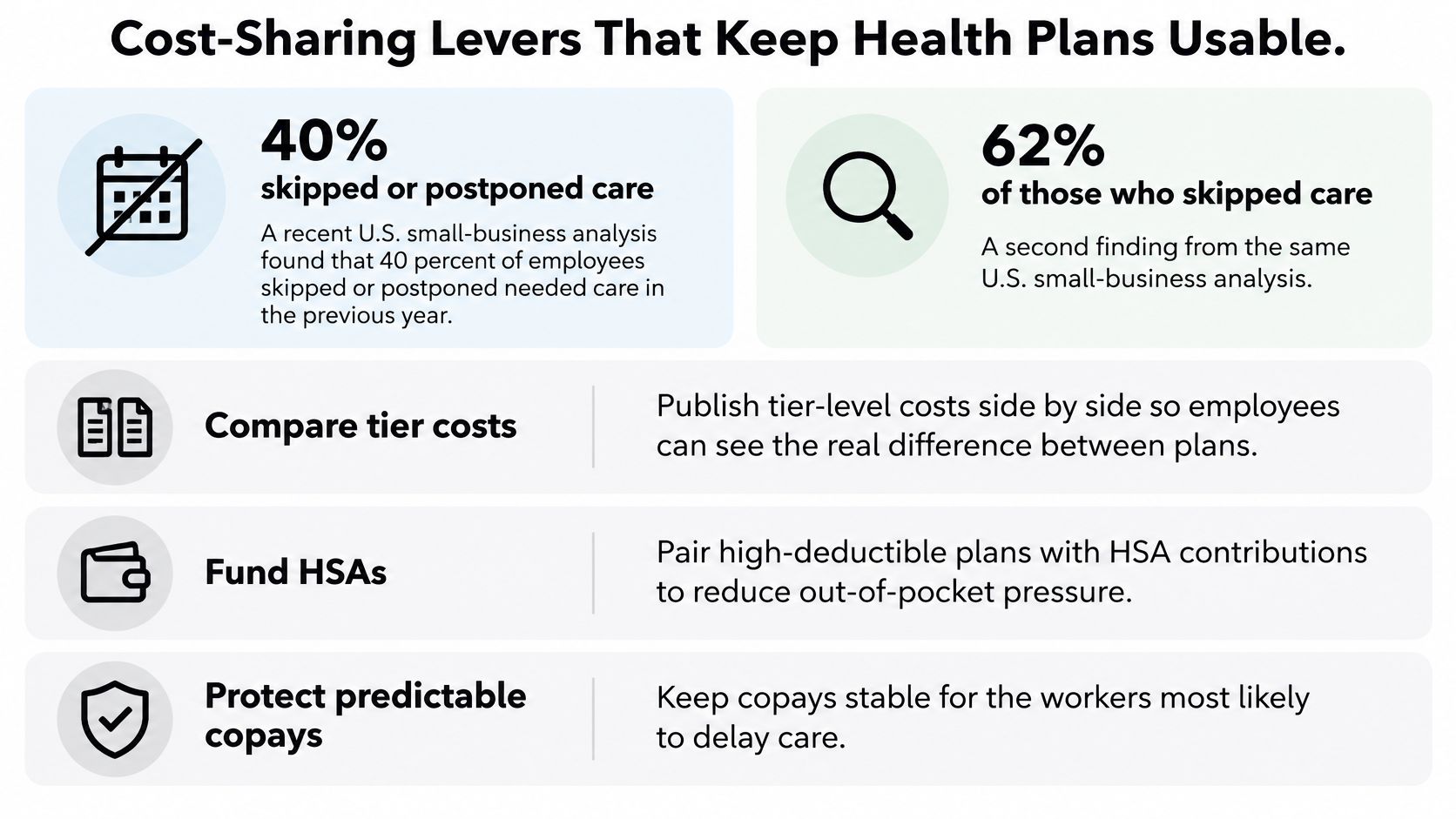
Employer-funded HRA. A health reimbursement arrangement can pay the first slice of each person's deductible. You cap the dollars, you see the claims category, and employees meet care without emptying a savings account.
Targeted deductible support. Put extra help on employees with dependents. They carry the largest exposure on a family plan, and a flat per-head stipend underfunds them relative to the single-coverage employee sitting next to them.
Richer preventive coverage. No-cost routine visits and screenings keep small problems from becoming deductible events. If the plan already covers prevention at no cost, do not buy a separate perk that duplicates it.
Tiered dependent contributions. Match the employer share to family cost instead of applying one percentage across every tier, so the parent on family coverage is not absorbing a dollar gap the single tier never sees.
Yearly prescription review. Check whether the medications your team fills fall under a copay or the deductible. Formularies shift between plan years, and a drug that moves behind the deductible is the bill that makes people skip refills.
Affordability is the whole stack, not the premium line. Total what an employee pays across deductible, copays, coinsurance, the out-of-pocket maximum, and prescription costs for someone who uses care in a normal year, then judge the plan on that number.
Say you move $80 a month, $960 a year, out of the employer premium share and into an HRA that pays the first $960 of the family deductible. The paycheck deduction may rise a little. The family's likely total cost falls in any year they would have paid that deductible themselves. I would start with that move before I added another voluntary plan.
HSA-Compatible HDHP Limits for 2026
An HSA-compatible HDHP lets employees set aside pre-tax dollars for qualified medical costs, and the employer can fund the same account. The IRS sets three tests each year. The plan has to pass all three or the account is not HSA-compatible, no matter what the brochure says. HSA contribution caps for 2026 are a useful cross-check when you brief employees on how much room is left after the company deposit.
| Coverage type | Maximum HSA contribution | Minimum HDHP deductible | Maximum out-of-pocket |
|---|---|---|---|
| Self-only | $4,400 | $1,700 | $8,500 |
| Family | $8,750 | $3,400 | $17,000 |
Those 2026 maximums, $4,400 self-only and $8,750 family, count employer and employee money together, per IRS Revenue Procedure 2025-19. The minimum deductible is $1,700 self-only and $3,400 family. The out-of-pocket limit cannot exceed $8,500 self-only or $17,000 family. Compared with 2025, the Mercer summary of the 2026 HSA and HDHP figures shows the self-only contribution rising from $4,300 to $4,400 and the family contribution from $8,550 to $8,750. The minimum deductible moves from $1,650 to $1,700 self-only and from $3,300 to $3,400 family. Employees age 55 or older keep a separate $1,000 catch-up.
Four checks before you call a plan HSA-compatible
- Confirm the deductible meets the minimum for that coverage type.
- Confirm the out-of-pocket maximum sits at or under its cap.
- Add employer funding and employee contributions, including the catch-up if it applies, and stop at the HSA limit.
- Update payroll and the enrollment guide with the plan-year figures before anyone elects.
An HDHP labeled HSA-compatible without those checks creates tax and enrollment problems. People discover the mistake at tax time, or the carrier rejects the funding file. Our HSA guidance for employers walks through funding and payroll setup so the account matches the plan you bought.
Closing the Retirement and Dental Access Gap
Small employers leave a visible hole, and a startup can close it without copying a large-company budget. The U.S. Bureau of Labor Statistics reported that in March 2025, retirement benefits were available to 59% of private-industry workers at establishments with fewer than 100 employees, 86% at establishments with 100 to 499 workers, and 90% at establishments with 500 or more. Across private industry, 72% of workers had access, and 70% had access to defined-contribution plans.
Dental is thinner still. The Urban Institute found that in 2024 only 27% of employees at private-sector businesses with 50 or fewer full-time-equivalent employees had access to dental benefits, compared with 59% at firms with 100 or more employees.
| Benefit | Employer size | Employees with access |
|---|---|---|
| Retirement benefits | Establishments under 100 employees | 59% |
| Retirement benefits | Establishments with 100-499 employees | 86% |
| Retirement benefits | Establishments with 500 or more employees | 90% |
| Retirement benefits | All private industry | 72% |
| Dental benefits | Firms with 50 or fewer FTE employees | 27% |
| Dental benefits | Firms with 100 or more employees | 59% |
A candidate comparing a 30-person company with a 500-person firm will see the missing plan. Say a 40-person startup adds a simple defined-contribution plan through a low-cost provider and a stand-alone dental add-on, then names both in the offer letter with the employee cost per paycheck. That is a realistic package. It does not require a match that blows the cash plan.
Decisions that keep the add-on affordable
Match or no match. A small match, or none in year one, still beats no plan. Say so in writing so people do not assume a match you cannot fund.
Automatic enrollment. Defaulting people in, with an easy opt-out, raises participation without a long education campaign.
Vesting. A short vesting schedule protects the company if someone leaves in month four, and it still looks fair if you explain it before the offer is signed.
Dental only helps if people can get a cleaning. Routine exams are the use case, which is why a plain description of preventive cleanings and exams belongs in the employee guide next to the copay.
Ask candidates three questions before you call the package done. Would you enroll a spouse? What would you pay per paycheck for dental? Does the retirement line change this offer against the larger company you are also considering?
How to Run Open Enrollment Without Errors
Open enrollment breaks when the guide, the election, and payroll describe three different plans. Six steps keep them aligned. Our open enrollment process runs on group virtual and in-person presentations, one-on-one counseling, a customized benefits guide, customized benefits videos, and a reconciliation of every enrollment against the carrier submission.
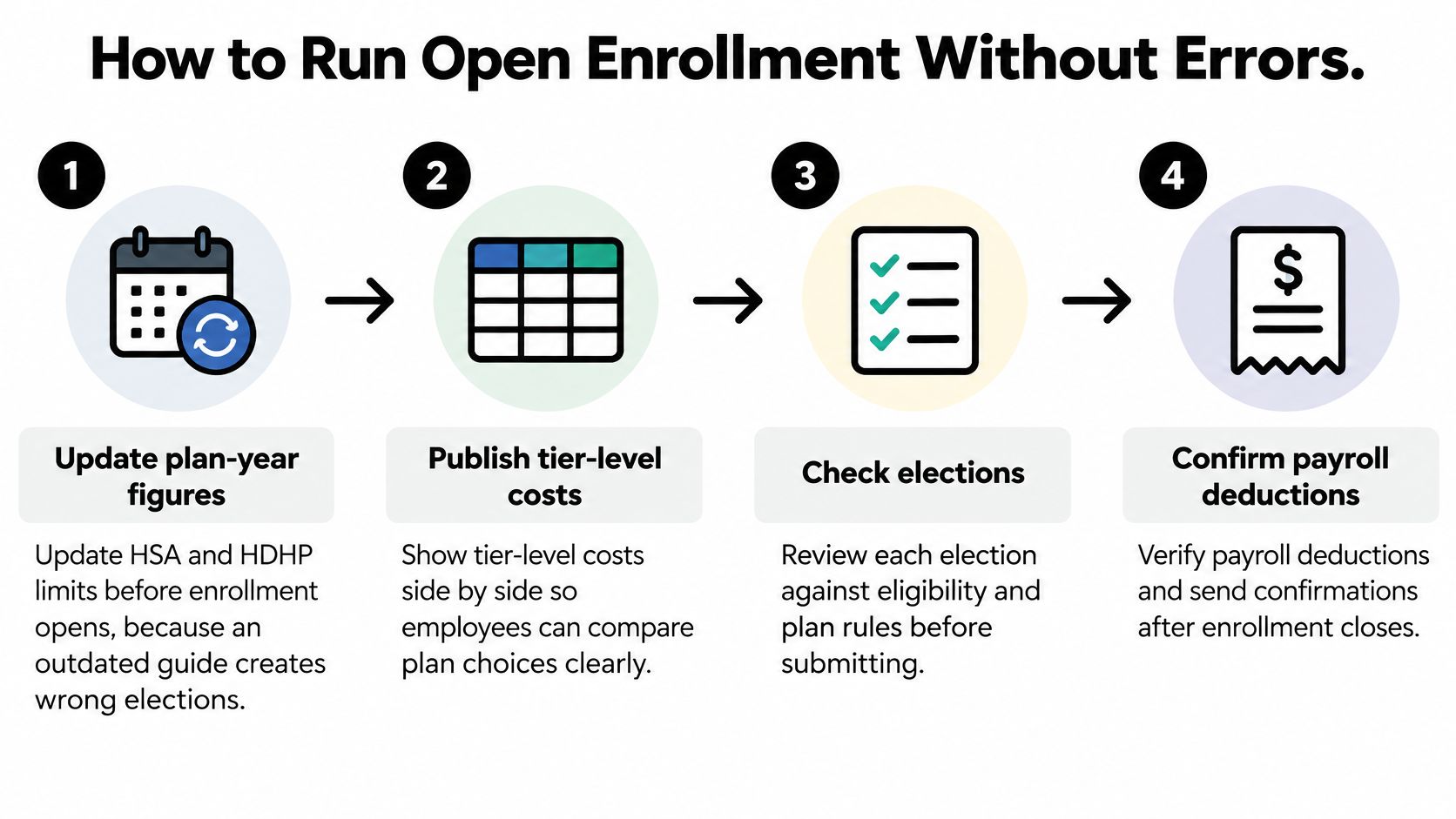
1. Update plan-year figures before the window opens. HSA and HDHP limits change every year. A stale deductible in last year's PDF produces wrong elections. The common slip is reprinting the prior guide with a new cover date.
2. Publish tier-level costs side by side. Show what each plan costs out of each paycheck, since that is the number people budget against. An employee who elects on a monthly premium can end up in a plan the paycheck cannot carry. The slip is publishing the employer share and calling it the employee cost.
3. Teach, then counsel. Hold one group session, virtual or in the room, then open one-on-one time for dependents and prescriptions. A group slide cannot answer a spouse's specialist network. A customized benefits video lets people recheck the details after the meeting ends. The slip is a single webinar and a closed inbox.
4. Collect every election in one window and reconcile it to the carrier file. A mismatched tier or a missing dependent is the error that surfaces months later as a claim denial. The slip is letting late email elections bypass the form.
5. Set payroll deductions and HSA employer funding from the confirmed elections. Draft elections change before the window closes. The slip is loading payroll the day the window opens.
6. Lock the compliance file. Record the plan-year figures you used, keep the election forms, and check which continuation-coverage and reporting duties apply at your current headcount. Confirm the applicable thresholds against IRS and carrier guidance for that plan year and store the source with the file. The slip is assuming last year's status still fits after a hiring surge.
A walkthrough of a clean window is worth watching before you build the calendar.
After this kind of rebuild, one gaming client's employees had a single open enrollment window and could view side-by-side plan comparisons online, including what each plan would cost them out of their paycheck. That is the standard. Every eligible employee has an election on file, payroll matches it, and nobody enrolls in a plan they have not seen priced against their own paycheck. A written open enrollment checklist for HR keeps steps 4 through 6 from living in someone's memory.
If the election file and the payroll register disagree, stop deductions until they match. Do not "fix it next cycle."
Set Your Benefits Budget Before Open Enrollment
Start from the stage you are in. Offer the benefits that fit that stage, and set each tier contribution from the employer and employee cost model, never from a blended premium. Then pressure-test the result the way an employee would: a plan the company can afford means little if the family-tier payroll deduction or the deductible prices people out of using it.
Check any HDHP and HSA pairing against the 2026 limits before either figure lands in an offer letter or a benefits guide.
Pick one cost-sharing lever for this plan year. I would pick the one that cuts family-tier employee cost first, usually an employer-funded HRA or targeted deductible support for people with dependents. A second voluntary plan can wait.
Then do one review before you shop carriers. Rate the current benefits process with our free benefits score at Benely. You get a read on where the process loses time, plus a free 30-page benefits guide, whether or not you go further with us. The same service, products, and support apply at 2 employees or at 2,000, with a dedicated team all year round and a phone call away instead of an 800 number.
Keep the review to three items: the budget figure by tier, the enrollment calendar, and the plan-year figures you will use to build elections and payroll. If any of the three is still rough, fix it before you compare plans, because each one changes what employees pay out of pocket.
Write down one budget figure and one enrollment date before you open a plan comparison. Those two lines stop a renewal from deciding the package for you.
Benely is a benefits brokerage and HR partner that helps startups compare medical, dental, vision, HSA, and retirement options, set a tier-level budget, and run open enrollment without a mismatched payroll file. If you want the package employees can afford to use, not only the one the company can afford to offer, start with a benefits score and a conversation at Benely. Bring your current tier costs and your next enrollment date.