
A daycare invoice arrives on the same morning your spouse has an important shift, your child's preschool needs payment, and a parent needs help getting through the day. You know the care makes work possible, but you may still wonder whether the expense belongs in a dependent care FSA, a tax credit, or neither.
The answer depends on the purpose of the care, the person receiving it, the provider, and your employer's plan. This guide explains what you can use a dependent care FSA for, which costs are excluded, how the 2026 contribution limits work, what records you need, and how employees and HR teams can avoid preventable claim problems. For broader benefits guidance and administration support, you can also explore Benely's benefits resources.
Table of Contents
- Introduction Why Dependent Care Costs Deserve a Smarter Strategy
- Understanding What a Dependent Care FSA Is and How It Works
- Eligible Expenses You Can Pay With Your Dependent Care FSA
- Ineligible Expenses and Common Misconceptions to Avoid
- Contribution Limits Tax Rules and How They Affect Your Family
- How Reimbursement Works Documentation and Employer Administration
- Making the Right Choice Practical Examples and Next Steps
Introduction Why Dependent Care Costs Deserve a Smarter Strategy
Working parents often make care decisions around employment rather than convenience. A preschool program covers the hours before a parent's workday ends. An after-school program keeps a child supervised until pickup. An adult day care program may allow an employee to remain at work while supporting a spouse or relative who can't care for themselves.
That work connection is the central idea behind a dependent care FSA. It isn't a general-purpose account for every family expense. It's a workplace benefit designed around care that enables you or your spouse to work, seek work, or attend school full time, subject to the rules of the plan and tax law.
Many families lose money through understandable mistakes. They assume kindergarten tuition qualifies because preschool does. They submit overnight camp fees because summer day camp qualifies. They include meals, transportation, activity charges, or tutoring on a receipt that otherwise contains an eligible care charge. These details can determine whether a claim is reimbursed.
The practical question: Would this care allow an eligible person to work, look for work, or attend school, and is the provider and service within the plan's rules?
The sections ahead separate the rules into usable decisions. You'll see examples of eligible child and adult care, clear exclusions, the 2026 limit change, the relationship between the FSA and the child and dependent care tax credit, and a reimbursement process that keeps documentation ready before a claim is denied.
Understanding What a Dependent Care FSA Is and How It Works
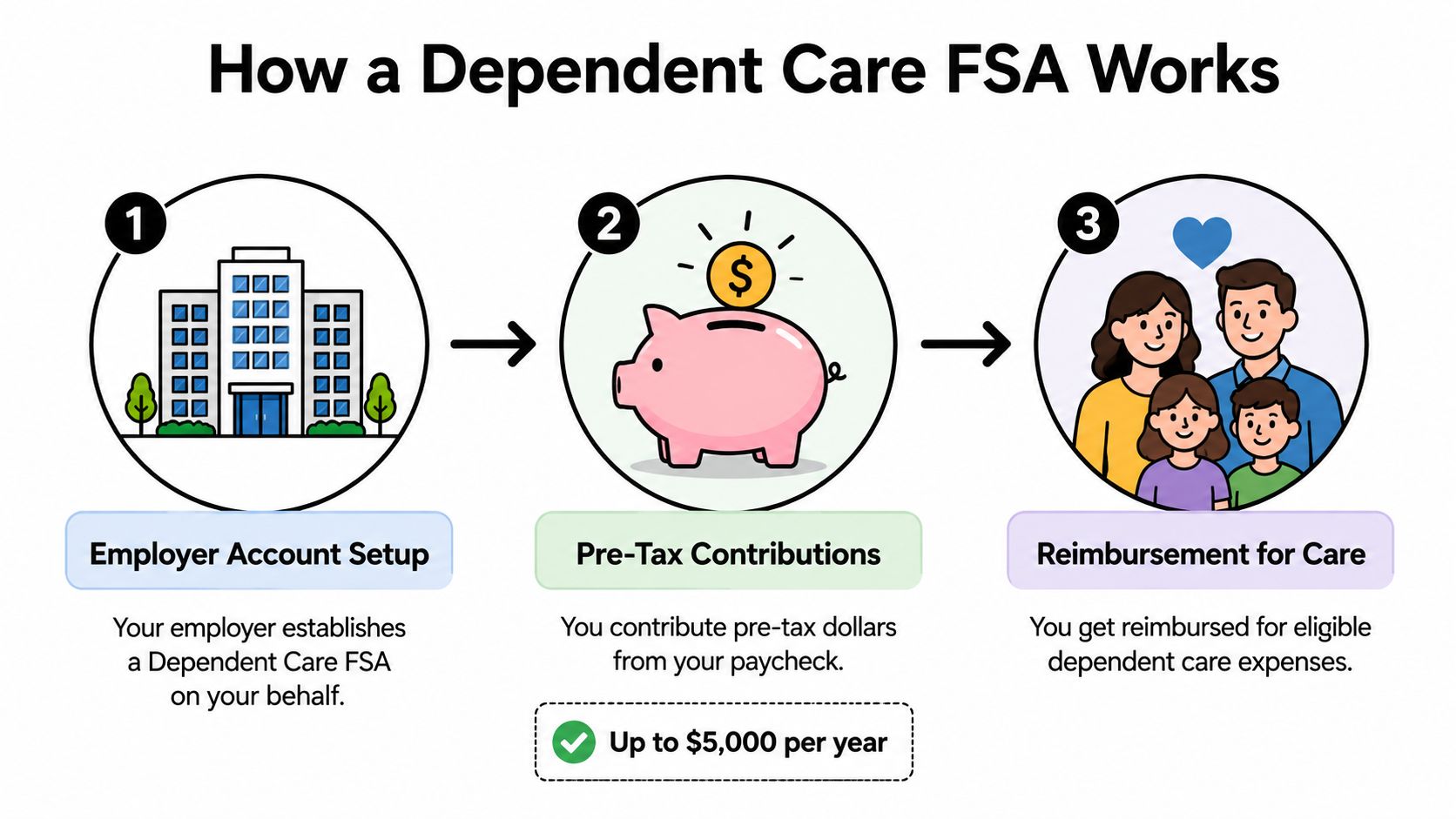
A dependent care FSA is an employer-sponsored account that lets an employee set aside money before taxes for qualifying dependent care. Think of it as a work-enabling subsidy. The account doesn't exist solely because a family has care bills. The care must generally make it possible for the employee and, when applicable, the employee's spouse to work, seek work, or attend school full time.
The qualifying person is usually a child under age 13 or an older spouse or relative who is physically or mentally unable to care for themselves. The care must also meet the plan's requirements, and the provider typically needs a tax identification number or Social Security number. A care provider who won't provide identifying information can create a reimbursement problem even when the service itself appears appropriate.
How the account differs from health accounts
A dependent care FSA isn't the same as a Health FSA or a Health Savings Account. A Health FSA generally addresses eligible medical expenses, while an HSA is tied to qualifying high-deductible health plan coverage. The dependent care account addresses qualifying care expenses instead.
You normally choose an annual election during open enrollment, through a new-hire process, or after an eligible life event under your employer's plan. Contributions then come from payroll, and you request reimbursement after you incur an eligible expense and provide the required documentation.
The account also has a use-it-or-lose-it structure, although an employer's plan may offer a grace period or another permitted plan feature. Don't assume unused money will remain available. Read your plan materials for the deadline to spend funds and the separate deadline to submit claims.
Why the work test matters
The work requirement helps explain many otherwise confusing outcomes. A babysitter can qualify when the parent is working, but a music lesson generally doesn't because the lesson is enrichment rather than custodial care. A daytime camp may qualify because it provides supervision while a parent works, while overnight camp generally doesn't fit the same rule.
Keep the purpose of the account in mind before you focus on the invoice label. The account follows the employment-related purpose of the care, not just the fact that a dependent attended or received a service.
Eligible Expenses You Can Pay With Your Dependent Care FSA
Eligible expenses usually fall into two broad groups, child care and care for an adult who can't care for themselves. The expense must remain connected to work, and the exact plan language still matters. FSAFEDS' eligible expense guidance provides a useful reference for categories such as child care, day programs, babysitting, and custodial elder care.
Child care in everyday settings
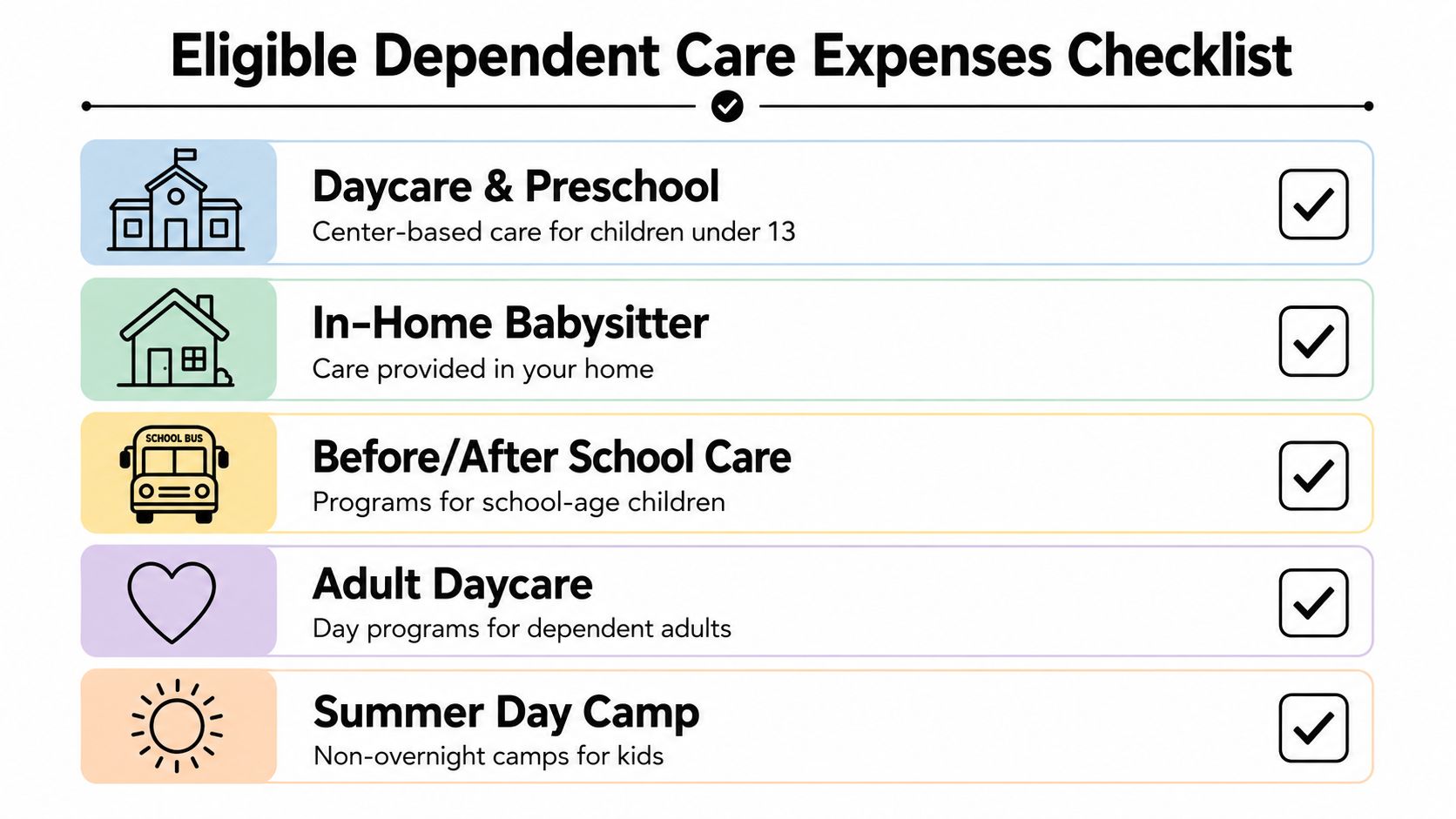
- Daycare and child care centers: Fees for care provided by a daycare facility may qualify when the care is for an eligible child and supports the parent's work schedule.
- Nursery school and preschool: Preschool can qualify when its primary function is custodial care. Keep separate records if the provider combines care with charges that aren't care services.
- Babysitting: Babysitting in your home or someone else's home may qualify when it allows you or your spouse to work. Ask the provider for the identifying information required by your plan.
- Au pair services: Au pair services may qualify when they provide eligible work-related care. Your administrator may request detailed documentation about the provider and the care arrangement.
- Before- and after-school programs: A program that supervises a school-age child outside school hours can qualify when the care supports employment.
- Summer day camp: A non-overnight day camp may qualify when its primary purpose is care while a parent works. Keep the camp invoice and dates of service.
The same invoice can contain both eligible and ineligible charges. A camp's daytime care fee may qualify, while a separately listed activity charge may not. Ask for an itemized statement rather than submitting a broad receipt that doesn't identify the care component.
Adult and elder care
Adult day care may qualify for a spouse or relative who is physically or mentally unable to care for themselves, provided the care is work-related. Custodial elder care can also qualify when it meets the applicable dependent care rules.
The word custodial matters. The account is focused on supervision and care that allows the employee to work, not on medical, dental, or vision treatment. If an adult care provider combines custodial services with medical services, request an itemization so the administrator can review the appropriate portion.
Documentation starts with the provider
Before enrolling, confirm that your provider can supply the information your plan requires. A provider name, tax ID or Social Security number, service dates, and amounts paid may all be necessary for substantiation.
For a second practical reference, this guide to FSA-eligible expenses in 2026 can help employees organize questions before they submit a claim.
A short video can also help families visualize the difference between qualifying care and unrelated services:
Ineligible Expenses and Common Misconceptions to Avoid
The easiest way to avoid a rejected claim is to stop treating the dependent care FSA as a broad family spending account. The service must be care, the care must support work, and the expense must fit the plan's eligible categories.
Education isn't automatically care
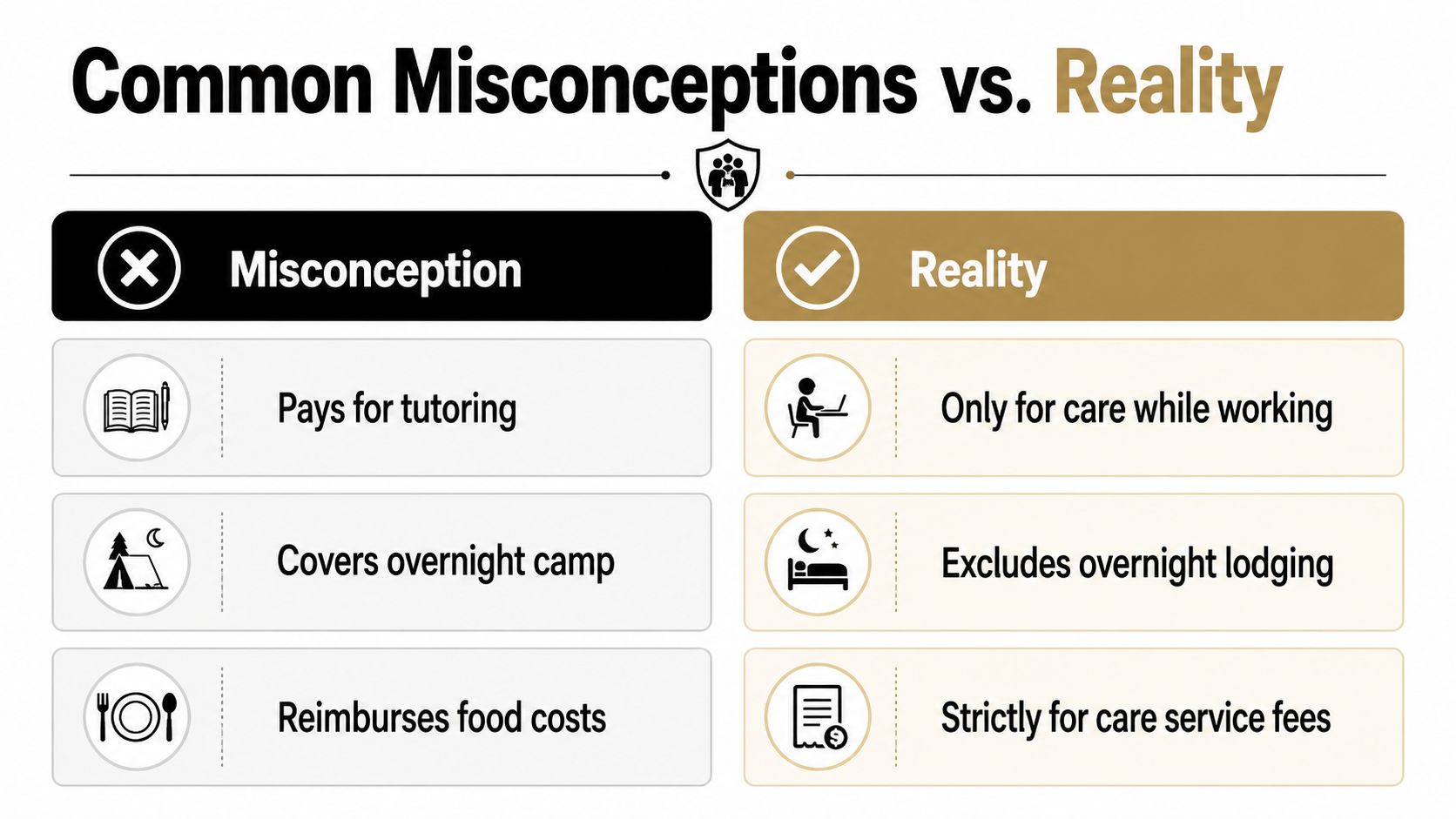
School tuition is generally excluded, including kindergarten tuition. Preschool may qualify when it primarily provides custodial care, but that doesn't make every school-related charge eligible. Tuition for an educational program and payment for supervision are not interchangeable simply because they happen during the workday.
Tutoring, dance lessons, and other activity fees also generally fail the work-enabling test. They may benefit the child, but their primary purpose is instruction or enrichment rather than supervision that lets a parent work.
Overnight and transportation rules
Overnight camp is generally excluded, even when a parent uses the camp because of work. Summer day camp is treated differently because it provides daytime supervision without the overnight lodging component.
Transportation requires careful review. Transportation not provided by the care provider can be excluded, and a separate transportation charge shouldn't be assumed eligible. If transportation is bundled into a care provider's service, ask the administrator how the plan treats that charge before submitting it.
Expenses that don't belong in this account
The following costs are generally ineligible:
- Kindergarten and school tuition: Tuition is education-related rather than qualifying custodial care.
- Overnight camp: Overnight lodging and camp costs fall outside the usual dependent care FSA treatment.
- Activity fees and dance lessons: Enrichment charges aren't the same as work-related supervision.
- Meals: Food costs aren't dependent care services.
- Medical, dental, and vision expenses: These belong, if eligible, under a health account or another tax treatment, not the dependent care FSA.
- Non-care transportation: Transportation outside the permitted care arrangement may be excluded.
Before submitting a mixed invoice: Circle the line items that pay for supervision, separate them from tuition or activities, and ask your administrator about anything that remains unclear.
A provider's invoice can make the distinction easier. Request separate descriptions for care, tuition, meals, activities, and transportation. That small administrative step gives the reviewer enough information to evaluate the claim instead of rejecting the entire invoice.
Contribution Limits Tax Rules and How They Affect Your Family
For tax years beginning on or after January 1, 2026, the federal dependent care FSA contribution limit increased. The applicable amount depends on filing status and whether the employer's plan has adopted the updated limit. The change is connected to the One Big Beautiful Bill Act, as summarized in the 2026 dependent care FSA update.
2026 Dependent Care FSA Limits at a Glance
| Rule | 2026 Amount | Who It Applies To |
|---|---|---|
| Annual household contribution limit | $7,500 | A household under the applicable federal rule |
| Married individuals filing separately | $3,750 | Each applicable married individual filing separately |
| Historical household limit | $5,000 | Prior federal limit for a household |
| Historical married filing separately limit | $2,500 | Prior federal limit for married individuals filing separately |
The FSAFEDS dependent care FSA overview reflects the 2026 limit increase and also explains the types of work-related care the account can cover. Employers should confirm that their plan document and payroll setup reflect the adopted limit rather than assuming the federal change automatically updates every plan.
The tax credit comparison
The dependent care FSA and the Child and Dependent Care Tax Credit address related expenses, but you can't use the same dollars twice. If an expense is reimbursed through the FSA, that same expense can't also be used to claim the tax credit.
IRS Publication 503 reflects a long-standing expense cap of $3,000 for one qualifying person or $6,000 for two or more qualifying persons. Those figures help explain why families should compare the tax treatment of their expected expenses rather than automatically choosing the largest available FSA election.
Your filing status, income, number of qualifying persons, employer plan design, and actual care costs all affect the decision. Families with specialized care needs may also benefit from reviewing broader resources, such as autism tax benefits by Guiding Growth, while keeping dependent care reimbursement separate from medical tax questions.
What HR teams should review
Employers need more than a payroll deduction code. Plan documents, eligibility language, communication materials, and nondiscrimination testing should align. A benefits team should also explain that the federal limit is a ceiling, not a promise that every employee will receive reimbursement without substantiation.
Employees can review Benely's explanation of FSA carryover rules for general planning context, but they should follow their current plan document for dependent care deadlines and unused-fund treatment.
How Reimbursement Works Documentation and Employer Administration
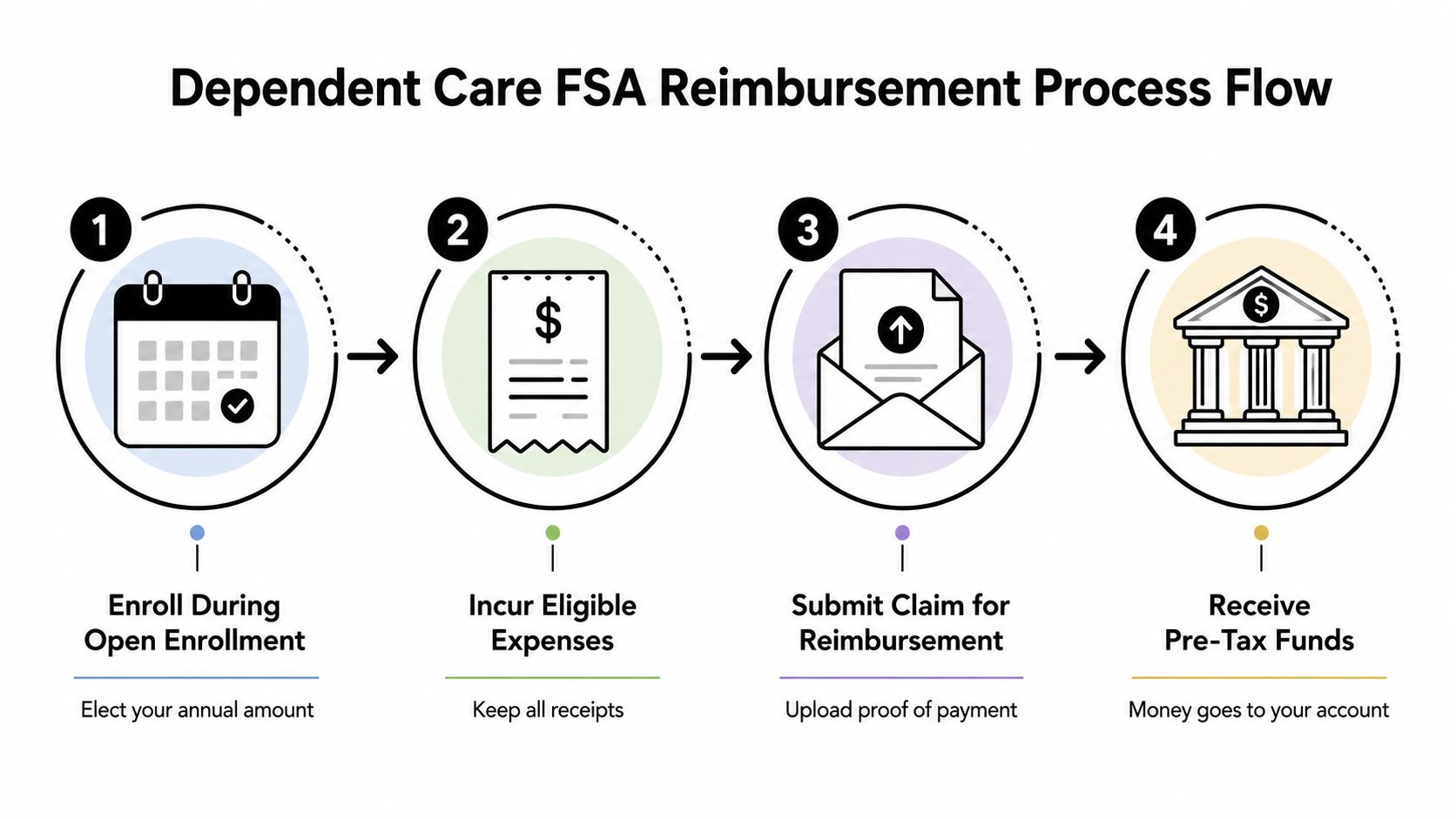
Reimbursement usually begins before the first claim. During open enrollment, elect an amount based on care you reasonably expect to incur, not on an optimistic guess about every possible expense. You'll generally pay the provider, retain proof, and submit a claim through the administrator or benefits platform.
A clean employee workflow
- Elect during enrollment: Choose an annual amount within the applicable limit and your employer's plan rules.
- Pay for care: Use your normal payment method unless your plan offers another approved option.
- Collect documentation: Keep the provider's name, tax ID or Social Security number, service dates, amount charged, and proof of payment.
- Submit the claim: Upload the itemized statement through your administrator's process.
- Watch the deadlines: Check the plan year, any grace period, and the run-out period for submitting claims.
Don't wait until the end of the plan year to ask for a provider's tax ID. A provider who can't supply required information may delay or prevent reimbursement.
For comparison, businesses handling international employee expenses may encounter different workflows, such as getting expenses reimbursed in the UK. That process isn't a substitute for U.S. dependent care FSA rules, but it illustrates why location-specific documentation and deadlines matter.
Employer administration pitfalls
HR teams should make the work-related purpose clear in enrollment materials. Employees need to know that care eligibility isn't enough by itself. The care must support work, the qualifying person must meet the applicable definition, and the claim must be substantiated.
Payroll integration also matters. Contributions should follow the employee's election, and administrators should communicate changes promptly when a plan adopts updated federal limits. Nondiscrimination testing and accurate plan language help employers manage compliance while giving employees practical instructions.
Employers seeking a structured way to coordinate enrollment, payroll connections, compliance tasks, and employee questions can review Benely's flexible spending account administration services. The right administrative workflow reduces avoidable back-and-forth, but employees still need to keep their own receipts and verify plan deadlines.
Keep one care folder: Store invoices, payment confirmations, provider information, and claim decisions together. It's easier to answer a documentation request when the records are already organized.
Making the Right Choice Practical Examples and Next Steps
A family paying for preschool and after-school care can total the expected eligible charges, then elect an amount that reflects those costs without adding uncertain activities or tuition. A couple relying on summer day camp should separate qualifying daytime care from excluded overnight or activity charges before estimating. An employee paying for a parent's work-related adult day care should confirm that the parent meets the plan's qualifying-person rules and that the provider can document the service.
Use this short decision check:
- Identify the care: Is it daycare, babysitting, a day program, or another qualifying care service?
- Confirm the person: Is the recipient a qualifying child or an adult unable to care for themselves?
- Test the purpose: Would the care enable you or your spouse to work, seek work, or attend school?
- Separate charges: Remove tuition, meals, activities, medical services, and excluded transportation.
- Verify the provider: Obtain the required identifying information before submitting a claim.
- Compare tax options: Don't claim the same expense through both the FSA and the Child and Dependent Care Tax Credit.
- Check deadlines: Review your plan's spending, grace-period, and run-out rules.
The most reliable election is based on documented, predictable care rather than the maximum available amount. HR teams can improve results by explaining these distinctions before open enrollment, while employees can avoid surprises by asking providers for itemized statements early.
Benely helps employers organize benefits enrollment, connect benefits administration with HR workflows, and support employees with practical guidance on programs such as dependent care FSAs. Visit Benely to explore benefits support that can make care-related elections and administration easier to manage.